The Privacy Illusion: Why the "Free" (and even Paid) AI Chatbot is a Data Mine
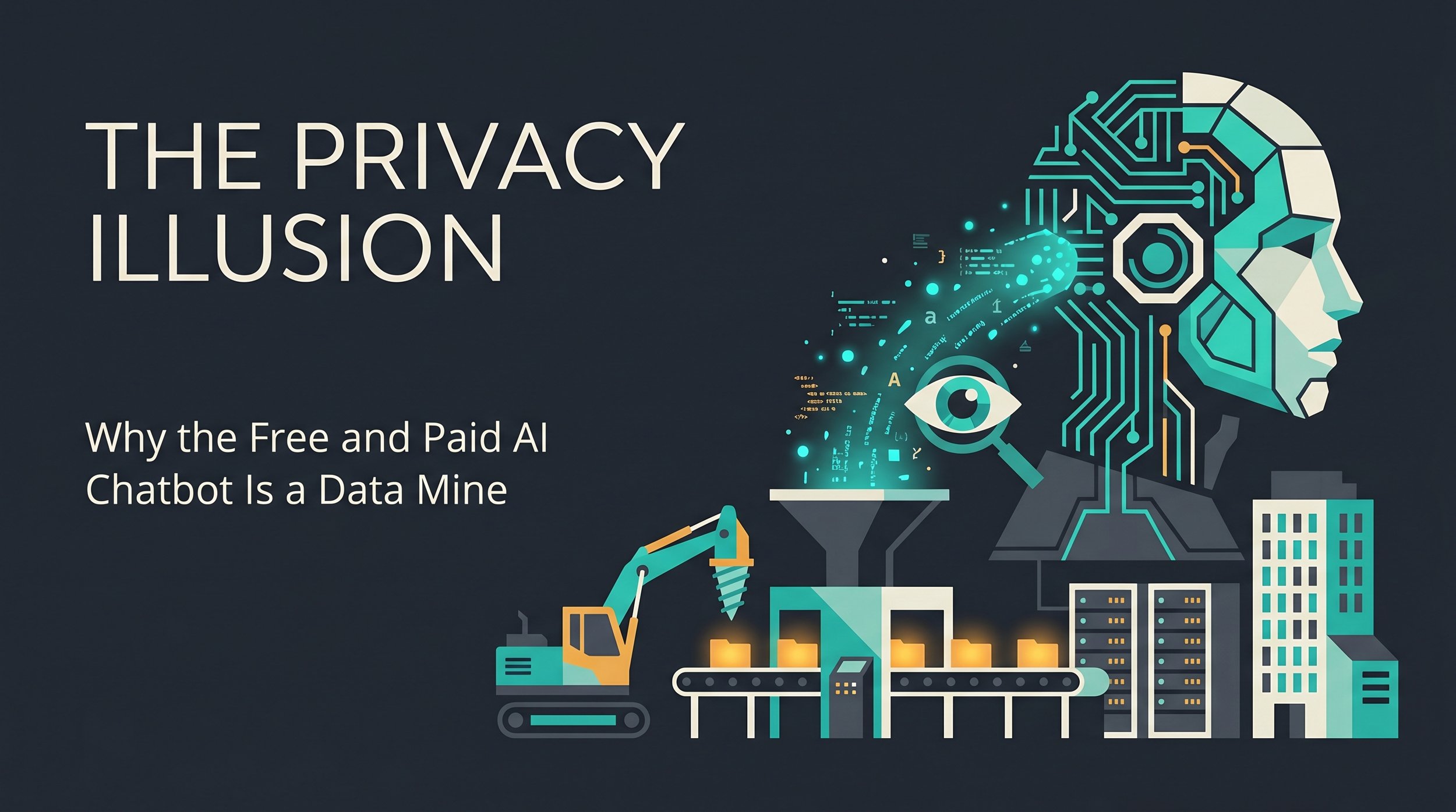
We have been conditioned to believe that if we pay for a service, we are the customer.
In almost every other sector of the economy, this is a fundamental truth. When you pay a lawyer, a doctor, or a mechanic, you are purchasing their expertise and their time. In exchange, you expect a professional standard of confidentiality. The payment is the barrier that ensures the service provider works for you, and only you.
But in the era of Large Language Models (LLMs), this logic has been systematically dismantled. We are entering the age of the "Intelligence Lease." When you pay $20 a month for a "Plus" or "Pro" AI subscription, you aren't buying a private tool. You are paying for a faster lane to a data-harvesting engine.
The reality is that whether you are using a "free" tier or a "paid" subscription, you are participating in the largest, most intimate data-extraction operation in human history. You are not the customer; you are the fuel.
The "Free" Tier: The Honest Trade
The "free" AI chatbot is the most honest part of the ecosystem because it doesn't pretend to be a secret. It is a classic "data-for-service" trade. You get access to a world-changing intelligence, and in exchange, you provide the raw material the company needs to stay competitive.
The RLHF Engine (Reinforcement Learning from Human Feedback) When you use a free AI, you aren't just a user; you are an unpaid data labeler. Every time you "thumbs up" a response or rewrite a prompt to get a better answer, you are performing RLHF. You are telling the company, "This is the correct way for a human to think/write/code."
The company is not giving you a service out of generosity; they are using you to refine their product. Every "free" chat is a training session. Your linguistic patterns, your errors, your logic, and your preferences are all ingested to make the next version of the model more "human." You are paying for the service with the very essence of your cognitive process.
The "Paid" Delusion: The Subscription Trap
The danger begins when we move to the paid tiers. There is a widespread belief that a monthly subscription acts as a "Privacy Shield." The assumption is: "If I am paying them, they don't need to sell my data."
This is a dangerous misconception.
In the world of AI, data is not just something you sell to advertisers, it is the very fabric of the product. The utility of an LLM is directly proportional to the diversity and quality of the data it has ingested. Therefore, the highest value data, the data from professionals, developers, and high net-worth individuals is the exact kind of data these companies want most.
The "Improvement" Clause If you read the Terms of Service (ToS) of the major AI providers, you will find that "paid" does not automatically mean "private." Many providers maintain a "default on" setting that allows them to use your conversations to "improve the model." Even if you pay for the service, your proprietary business strategies, your unique code snippets, and your private creative processes are being ingested into a model that may later "suggest" those same ideas to your competitors.
You are paying for a subscription, but you are still providing the raw materials. You are paying them for the privilege of training their next model on your intellectual property.
The Architecture of the Mine: How Your Data Moves
To understand why this is so risky, we must examine the physical and digital path your data takes. When you type a prompt into a cloud AI, your data doesn't just "go to a computer", your data enters a complex pipeline designed for extraction.
1. The Ingress and the Log Every prompt is sent over HTTPS to a remote server. But it doesn't just go to the model; it goes to a log. Every interaction is timestamped, tokenized, and stored. These logs are the goldmine for the company. They allow them to track user behavior, identify "edge cases" where the model fails, and build psychological profiles of their user base.
2. The Human-in-the-Loop (The "Anonymity" Myth) Companies often claim that data used for training is "anonymized." But in the world of LLMs, anonymity is a myth. If you paste a specific piece of code or describe a unique life situation then a human contractor, often working in a low wage region for a data labeling firm can easily deduce who you are. Thousands of human "graders" read these "anonymous" logs to ensure the AI isn't being toxic. Your most private thoughts are, quite literally, being read by strangers.
3. The Weights of the Neural Network The most terrifying part of the data mine is that it is permanent. Once your data is used to train a model's "weights," it cannot be "deleted." You can ask a company to delete your account, but you cannot ask them to "un-learn" the patterns it learned from you. Your intellectual property becomes a permanent part of a mathematical matrix that you no longer control.
The "Sovereign" Alternative: Local AI
There is a way to have the intelligence of an LLM without the surveillance of a cloud provider. It is the only way to ensure that your thoughts remain your own.
Local AI is the only true privacy.
By running models locally by using tools like Ollama or local backends you dismantle the data mine at the source.
Zero Transit: Your prompts never leave your RAM. There is no "ingress" and no "remote server."
Zero Logs: There is no corporate database recording your history. The only one who knows what you asked the AI is you.
Zero Training: Your data is not used to train a model you don't own. You are using a frozen snapshot of a model's knowledge, but you are not adding your life to its training set.
When you run a model locally, you transition from a "user" to an "operator." You are no longer renting intelligence; you are utilizing a tool on your own property.
Integrating Intelligence without the Trap
The leap to local AI can feel daunting, people worry about hardware requirements or "dumb" models. But the technology has reached a tipping point. Local models (like Qwen or DeepSeek) are now capable of handling most professional tasks.
This is where the Sovereign Stack becomes essential. Using a local model is step one, but making it useful is step two.
SearchBox: Instead of uploading your private documents to a cloud AI to "summarize" them, SearchBox indexes them locally. The AI "sees" your data, but the data never leaves your disk.
Model Context Protocol (MCP): This is the final piece of the puzzle. MCP allows you to connect your local AI to your local tools (like your files, your databases, or your 3D printer).
You can now have a personal AI assistant that knows everything about your business and your home but tells absolutely nothing to the world. You have the power of a global LLM with the privacy of a vault.
The Choice: Consumer or Owner?
The AI era is the ultimate test of our digital sovereignty. We are at a crossroads. We can continue to be "digital tenants," paying a monthly fee to have our thoughts harvested by a handful of billionaires in a few data centers in Virginia and California.
Or, we can become Sovereign Operators.
The transition to local AI is more than a technical choice; it is a political and ethical statement. It is a declaration that your intellectual property, your private internal monologue, and your digital identity are not "training data" for a corporate a-product.
Stop feeding the mine. Stop renting your intelligence. Start owning the machine.
Note: Also check out the case for local model hosting here for reasons why you should host your own AI.
Stop renting your digital existence.
Buy a board, spin up a container, take your data back.
