The Case for Local Model Hosting
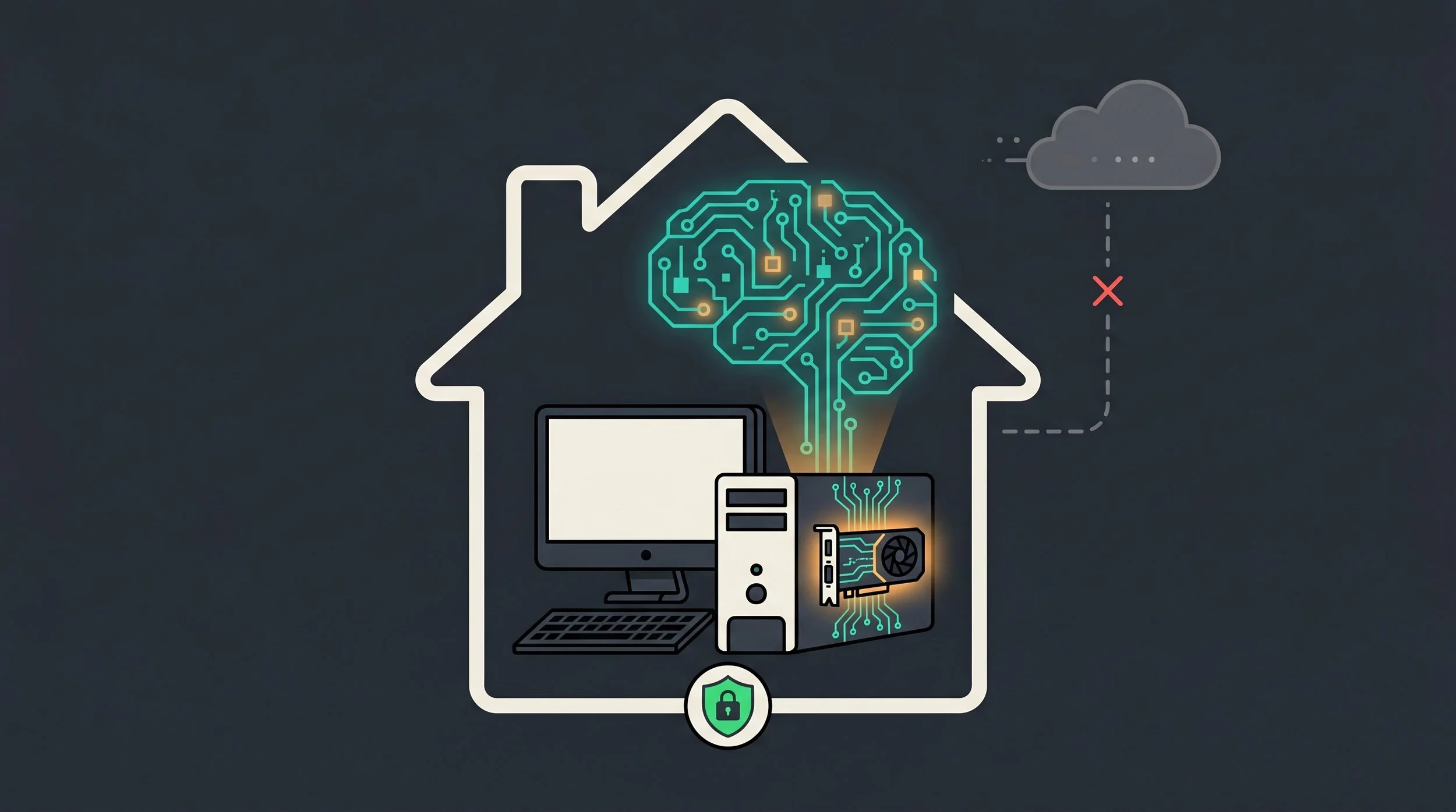
Computer house with circuit brain coming from GPU
By S’Bussiso Dube/SourceBox Team
Updated June 9, 2026
Intro
Every time you send a prompt to ChatGPT, upload a document to a cloud-based AI service, or use an intelligent assistant, your data takes a journey. It leaves your device, travels through internet infrastructure you don't control, arrives at servers owned by companies with their own interests, and gets processed in ways you can't fully see or audit. We've normalized this arrangement because the convenience is undeniable. But the cost is measured in privacy, autonomy, and long-term control.
The alternative isn't some fringe technical exercise. Running AI models locally, on hardware you own and manage, has become genuinely practical in 2026. The tools have matured, the hardware has become accessible, and the models themselves have grown efficient enough to run on consumer-grade equipment. What was once the domain of research labs and tech giants is now available to businesses, developers, and even determined hobbyists.
This isn't about rejecting progress or cloud computing wholesale. It's about recognizing that for many use cases, particularly those involving sensitive data, regulatory requirements, or long-term independence; local hosting offers compelling advantages that no amount of cloud convenience can match.
Why Privacy Actually Matters in the Age of AI
The privacy argument for local AI hosting goes beyond abstract concerns about data collection. When you process information through cloud-based AI services, you're creating a permanent record of your queries, documents, and interactions on someone else's infrastructure. That record exists in databases you can't access, under policies that can change, subject to legal demands you won't know about.
Consider what you might legitimately want to process with AI: medical records, financial documents, legal contracts, proprietary research, personal correspondence, business strategies. The more powerful AI becomes, the more sensitive the information we'll want to analyze with it. Cloud providers offer encryption and security certifications, but they also hold the keys. They can see your data. Their employees can potentially access it. Governments can subpoena it. Breaches can expose it.
Local hosting eliminates this entire threat surface. When your data never leaves your network, the attack vectors shrink dramatically. You're not trusting a third party to maintain security, you're implementing your own security policies, with your own audit trails, under your own control. For healthcare providers bound by HIPAA, financial firms navigating GDPR, or any organization with genuine data sovereignty requirements, this isn't optional. It's foundational.
The psychological dimension matters too. There's a difference between knowing intellectually that a service "protects your privacy" and knowing concretely that your data physically never left your building. One requires trust in corporate promises and legal agreements. The other requires trust in your own security practices. For many, that's a trade worth making.
Infrastructure Control: Beyond Privacy
Privacy is the headline argument, but infrastructure control runs deeper. When you host models locally, you own every layer of the stack. You choose the hardware, whether that's a modest GPU, an edge device, or a rack of specialized inference accelerators. You select the software versions, configure the network, and decide exactly how data flows through your systems.
This granularity matters for compliance. Regulated industries don't just need to protect data, they need to prove they're protecting it, with audit trails that show exactly where information went and who touched it. Cloud providers can offer compliance certifications, but they can't give you the level of detailed control that internal auditors sometimes demand. When you run the infrastructure, you can instrument every step, log every transaction, and demonstrate compliance in ways that satisfy even strict regulatory frameworks.
There's also the question of customization. Cloud AI services are built for general use cases, which means they're optimized for the average customer. If you have specialized needs like unusual input formats, custom preprocessing pipelines, integration with legacy systems then you're often working against the grain of what the service was designed for. Local hosting lets you modify the entire pipeline to fit your specific requirements. Need to integrate with a 20-year-old database system? Want to preprocess data in a particular way? Have strict latency requirements that demand specific hardware configurations? All achievable when you control the infrastructure.
Vendor lock-in deserves special attention. When you build applications around a cloud API, you become dependent on that provider's pricing, availability, and feature set. Prices can increase. APIs can change. Services can be deprecated. Companies can be acquired. Your application's future is tied to decisions made in boardrooms you have no influence over. Local hosting breaks this dependency. Your models run on open-source software, using standardized formats, on hardware you own. You can migrate, upgrade, or modify your setup without negotiating with vendors or refactoring your entire application.
The Economics of Local AI
The financial case for local hosting is more nuanced than simple cost comparison, but it's compelling for many scenarios. Cloud AI services typically charge per API call, per token processed, or based on compute time. For light usage, this model is economical because you pay only for what you use. But as usage scales, the math changes dramatically.
Consider a medium sized business that processes 10 million tokens daily through a commercial API at $0.002 per thousand tokens. That's $20 per day, or roughly $7,300 annually. A capable GPU server that could handle this workload might cost $3,000-5,000 upfront, with perhaps $500 yearly in electricity. The hardware pays for itself within a year, and subsequent years see dramatic savings.
The Break-Even Math
At roughly 10 million tokens a day, the API meter never stops — but the hardware is a one-time cost. After about a year, every query you run is essentially free.
The calculation shifts further when you factor in development and experimentation. Cloud services charge for every query, which means testing, debugging, and iterating on AI features accumulates costs rapidly. Local hosting eliminates this friction. You can experiment freely, run thousands of test queries, and iterate quickly without watching a billing meter tick up. For organizations building AI-driven products, this freedom has real value.
There are legitimate counter arguments. Local hosting requires technical expertise that has its own cost. Hardware maintenance takes time. Scaling past a certain point requires additional investment. But for many use cases particularly those with predictable, sustained workloads and technical capacity—the economics favor local hosting decisively.
The Practical Reality: Tools and Approaches
The tooling ecosystem for local AI hosting has matured remarkably. Ollama has emerged as a particularly significant platform, offering a streamlined way to download, run, and manage large language models on local hardware. You can have a capable language model running locally with just a few commands.
The Hugging Face ecosystem provides the model repository and training infrastructure. Their Transformers library has become the de facto standard for working with modern AI models, and their Hub offers thousands of pre-trained models that you can download and run entirely offline.
LangChain adds another layer, enabling sophisticated applications that chain multiple AI operations together, integrate with databases and APIs, and manage complex workflows all while keeping data on your infrastructure. Pair it with a local Ollama instance, and you can build genuinely powerful applications that never touch external APIs.
The point is that this isn't bleeding-edge experimental technology anymore. These are mature, well-documented tools with active communities and robust support. The barrier to entry has dropped considerably.
The Technical Challenges Are Real But Manageable
Local AI hosting does present genuine challenges that deserve honest discussion.
Hardware requirements can be substantial. Large models need significant VRAM, and not everyone has access to high-end GPUs. However, quantized models, distillation techniques, and CPU-optimized inference have made surprisingly capable models accessible on consumer hardware. An M-series Mac, a modern gaming PC, or even a well-configured Linux server can run useful models.
Software complexity exists. Setting up CUDA, managing Python dependencies, and troubleshooting GPU drivers can be frustrating. But containerization via Docker largely solves this—pre-built images encapsulate working configurations, and you can deploy them without deep expertise in every component. The community has also produced extensive documentation and guides.
Scaling presents challenges. A single workstation has limits. If your application grows to serve thousands of concurrent users, you'll need horizontal scaling—multiple servers, load balancing, orchestration. Tools like Kubernetes can handle this, but the complexity increases. For many applications, though, a single well-configured server provides more than adequate capacity.
Security requires attention. If you expose an inference API to the network, you need proper authentication, firewall rules, and monitoring. This is standard DevOps practice, but it's a responsibility you're taking on rather than outsourcing. The flip side is that you get to implement exactly the security model your requirements demand, rather than accepting a provider's one-size-fits-all approach.
Model updates and maintenance are ongoing responsibilities. New model versions release regularly, security patches emerge, and dependencies need updates. Automation through CI/CD pipelines can handle much of this, but someone needs to design and maintain those pipelines.
These challenges aren't trivial, but neither are they insurmountable. Organizations with even modest technical capacity can successfully implement local AI hosting. The question is whether the benefits of privacy, control, economics, and compliance justify the effort for your specific use case.
Getting Started: A Realistic Approach
If you’re curious about bringing AI onto your own machine, start with a clear purpose.
Think in terms of what problem you want to solve such as summarizing your own documents, answering questions about your personal data, or running a private chatbot rather than the underlying technology itself. Local AI means your data stays on your device and isn’t sent to a cloud service, improving privacy and reducing ongoing costs.
Pick a model that fits your goals and hardware. There are many open-source language models available on repositories like the Hugging Face Model Hub and Ollama or LM Studio. some are lightweight enough to run well on everyday laptops, while others benefit from more powerful computers. Next, install a local AI tool that makes running that model easy. Tools like Ollama are designed to simplify model management and inference across platforms (Windows, macOS, Linux).
As you begin, experiment with simple queries so you can understand how the model responds and where it’s strongest or weakest for your use case.
Once you’re comfortable with basic interaction, think about how you’ll use the AI whether that’s through a simple interface on your own computer or as part of a personal project. Keep your setup lightweight to start and document what you’re doing so you can refine it over time.
Don’t worry about scaling or complexity at first. Focus on solving a clear, immediate need with the tools available, and let your local AI grow more capable as you learn its strengths and limitations.
Conclusion
The central question isn't whether cloud AI services are bad or local hosting is always superior. Both approaches have legitimate uses. The question is: for your specific needs, with your data, under your constraints, which model gives you the outcomes you actually want?
If you're handling genuinely sensitive information, if you have strict compliance requirements, if you value long-term independence, if you want to avoid recurring costs that scale with usage, if you need deep customization—local hosting deserves serious consideration. The technology is ready. The tools exist. The economics often make sense. What's required is the decision to take control of your AI infrastructure rather than outsourcing it by default.
The future of AI doesn't have to be exclusively centralized. We can build a world where powerful AI capabilities are distributed, where privacy is protected by design rather than policy, where control rests with the people using these tools. Local model hosting is how we get there—one deployment at a time, one organization at a time, one person at a time deciding that control matters.
The infrastructure is in your hands. The question is whether you'll use it.
Stop renting your digital existence.
Buy a board, spin up a container, take your data back.
