Why “The Cloud” is Just a Fancy Word for “Someone Else's Computer”
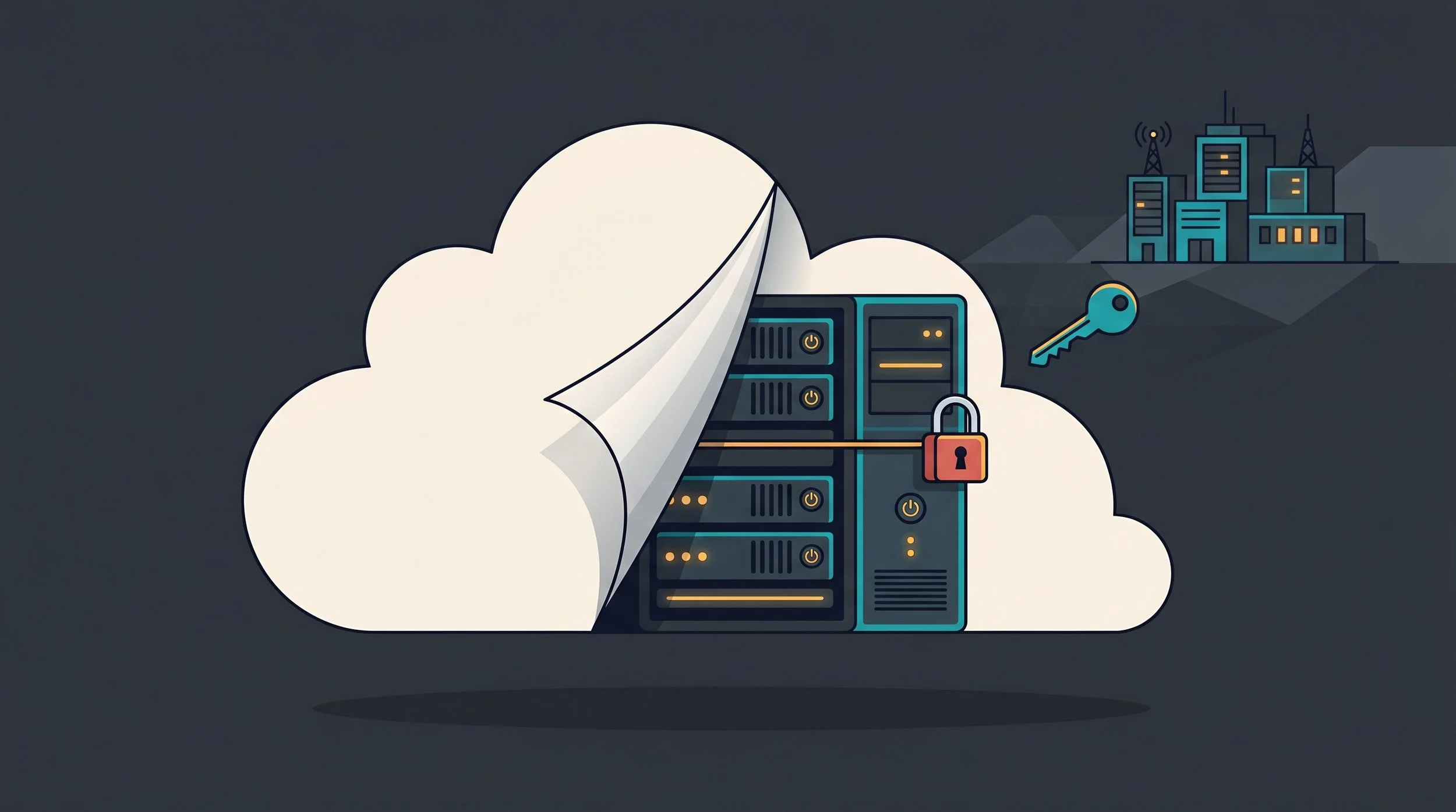
fluffy cloud peels back like a sticker to expose the server rack
By S’Bussiso Dube/SourceBox Team
In the modern tech world, we talk about "The Cloud" as if it’s a mystical, ethereal place. We say our photos are "in the cloud" or our documents are "cloud-based," as if they’ve been uploaded into terms of a digital atmosphere.
But for those of us who build the infrastructure, we know the truth: the cloud isn't a place. It’s just a business model. At its most basic physical level, the cloud is simply someone else's computer.
The Utility of the Cloud: Why We Use It
First, let's be honest: the cloud is an incredible achievement. The ability to access your data from any device, anywhere in the world, has fundamentally changed how we work and live.
Cloud services provide a critical set of advantages:
Instant Scalability: You don't have to buy a new server every time your data grows; you just slide a toggle in a dashboard.
Accessibility: Syncing a file between a laptop, a tablet, and a phone is seamless because the "source of truth" is centralized.
Managed Stability: Professional data centers provide redundancy, power back-ups, and physical security that are nearly impossible to replicate in a home living room.
For many of us, the cloud is a vital utility. It's the "electric grid" of the digital age.
The Hidden Trade-off: The Ownership Gap
However, the convenience of the cloud comes with a technical trade-off that often goes unmentioned: the loss of direct ownership. You go from owning your own infrastructure to becoming a digital tenant.
When you rely entirely on a cloud provider, you are essentially "renting" your digital existence. At some point you realize there is a price of convenience. You are trusting a third party to maintain the uptime, protect the privacy, and sustain the existence of your data. While most providers are reputable, this creates a dependency. If a service changes its pricing, updates its terms, or experiences a catastrophic outage, you are a passenger in that process. You have the convenience, but you've surrendered the control.
This is the "Ownership Gap." It's the difference between owning the land and renting an apartment. Both provide a place to live, but only one gives you the freedom to decide exactly how the walls are painted and who has a key to the door.
The Real-World Difference: Cloud vs. Local-First
To see why this distinction matters, consider how these two models handle common, real-world situations:
Scenario A: The Internet Outage
The Cloud User: Your internet goes down for four hours. Suddenly, you can't access your documents, your smart home automations stop working, and your "smart" security cameras are just expensive pieces of plastic. Your home is effectively "frozen" until the provider restores the connection.
The Local-First User: Your internet goes down, but your life doesn't. Your files are on your disk, your AI is running on your GPU, and your security cameras are recording to your local vault. The cloud is a bonus, not a dependency.
Scenario B: The "Account Locked" Nightmare
The Cloud User: You wake up to a "Your account has been suspended" message. You don't know why, and the support team is a bot. You have lost access to your emails, your files, and your identity in a single second.
The Local-First User: You might lose access to a specific cloud service, but your "Source of Truth" remains on your hardware. You simply point your tools to your local backup and keep working.
Scenario C: The Latency Lag
The Cloud User: You ask a cloud AI to analyze a 50MB document. The file is uploaded, processed in a data center 1,000 miles away, and the answer is streamed back. It takes 15 seconds and uses your bandwidth.
The Local-First User: The AI reads the file directly from your NVMe drive. The response is near-instant because the data never has to travel.
The Right Balance: Local-First, Cloud-Optional
At SourceBox, we don't believe the answer is to reject the cloud entirely. That would be a step backward in productivity. Instead, we advocate for a Hybrid Approach: the Local-First, Cloud-Optional model.
The goal is to move the "Foundation" of your digital life back to your own hardware, while using the cloud as a convenient layer on top.
Local-First for Sovereignty: Your primary data, your most private documents, and your core AI intelligence should live on your own hardware. This ensures that even if the internet goes down or a provider disappears, your "Digital Home" remains intact.
Cloud-Optional for Convenience: Use the cloud for what it's best at: remote access, seamless syncing, and high-scale backups.
By structuring your tech this way, the cloud becomes a choice, not a requirement. You get the best of both worlds: the absolute security of owning your hardware and the effortless accessibility of a managed service.
Note: You can also check this open source guide here for a large list of open-source alternatives.
Building a Balanced Digital Life
Reclaiming terms of your digital existence doesn't mean you have to become a hermit in a server room. It just means being intentional about where your "Source of Truth" resides.
The first step is simply asking: "If this service vanished tomorrow, would I still have my data?"
If the answer is "No," it's time to start building your own foundation. Start small. Move one folder to a local drive. Run one local AI model. Set up one private backup.
When you move your foundation to your own hardware, the cloud stops being a risk and starts being a utility. You stop renting your digital life, and you start owning it.
Stop renting your digital existence.
Buy a board, spin up a container, take your data back.
