The Sovereign Office: Building a Business That Can't Be 'Cancelled' or 'Logged Out'
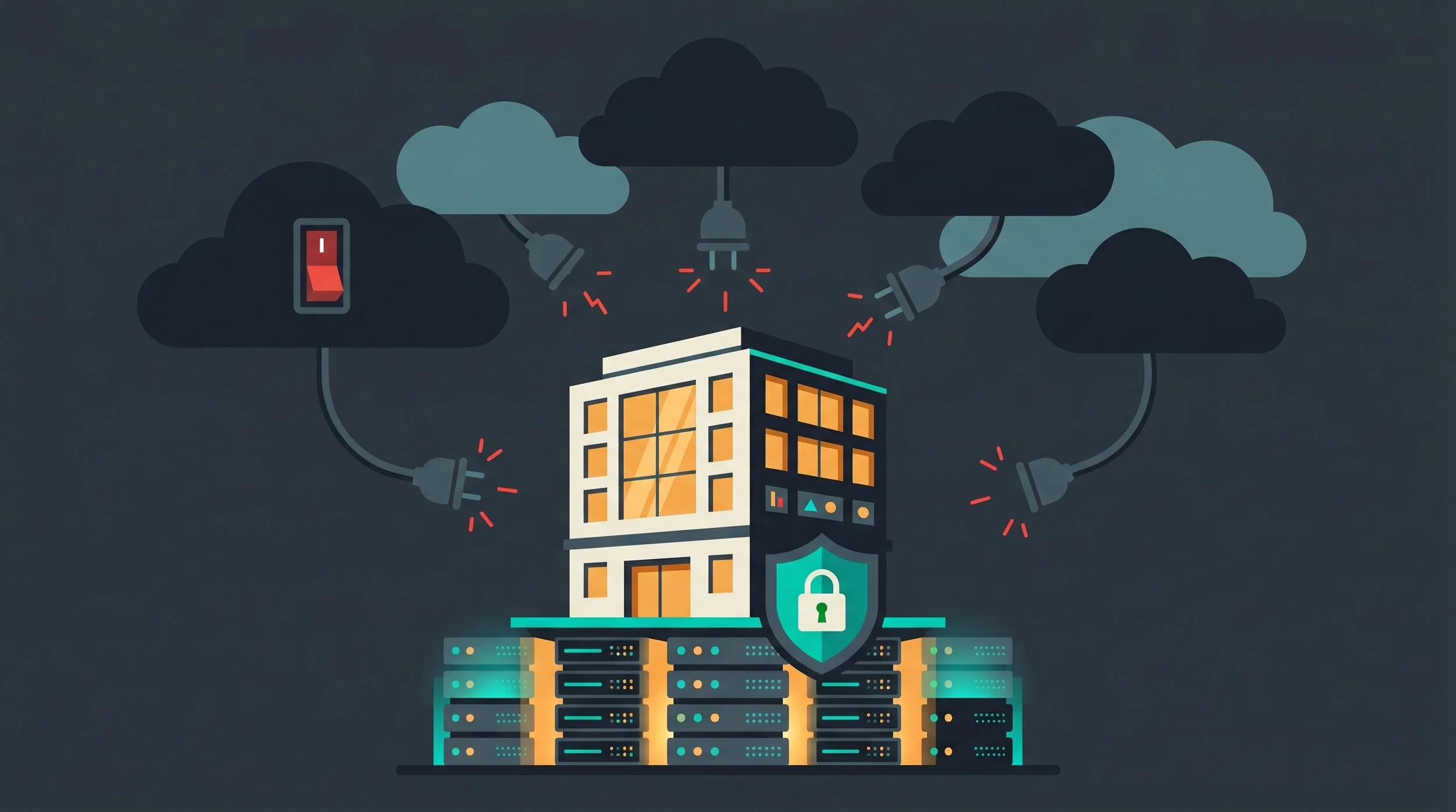
An office building whose foundation is its own server rack
In the modern economy, most small businesses aren't actually "owners" of their operations. They are digital tenants.
We rent our email from Google. We rent our documents from Microsoft. We rent our customer relationships from Salesforce. We rent our payment processing from Stripe. To the business owner, this looks like "efficiency" using the advantage of the cloud. But to the corporate provider, this is a "dependency."
When you rely on a third-party SaaS (Software as a Service) for your core operations, you are granting that provider a "kill switch" over your business. If an account is suspended, a payment processor drops you, or a host pulls the plug based on a change in the Terms of Service, your business doesn't just slow down, it ceases to exist.
Digital sovereignty is not a luxury; it is a business continuity strategy.
Note: You can also check this open source guide here for a larger list of alternatives.
The Reality of the "Kill Switch"
The threat of "deplatforming" is often dismissed as a remote possibility, but the precedents are verified and systematic. We have seen a pattern where the infrastructure of the internet is used as a tool for financial and social censorship.
The Hosting Cut-off: In 2021, AWS suspended Parler's account, citing ToS violations. Almost overnight, terms of service became a tool for total digital erasure.
The Infrastructure Void: The "Daily Stormer" incident saw a domain revoked by GoDaddy and Google, while Cloudflare terminated their account. In a matter of hours, a digital entity was erased from the same "Cloud" it had paid to inhabit.
The Financial Freeze: During the 2022 Canada convoy protests, financial institutions were ordered to stop providing services to associated individuals, freezing accounts and cancelling cards without a court order.
Most recently, in March 2026, the FTC issued formal warning letters to the CEOs of PayPal, Stripe, Visa, and Mastercard, raising concerns that "debanking"—the act of shutting off financial access to legal businesses—may violate the FTC Act.
The lesson is clear: If you do not own the rails, you do not own the train. There is a price of convenience
The Sovereign Stack: A Function-by-Function Blueprint
Building a sovereign office doesn't mean abandoning the cloud or retreating into a darkroom. It means moving your Foundation; your identity, your data, and your core tools onto infrastructure you control.
The goal is to separate your utility from your ownership. You can still use the cloud for convenience (remote access, offsite backups), but you never allow a third party to be the sole gatekeeper of your business.
Here is the architectural blueprint for a professional, sovereign office.
The Identity Root: Domain, Secrets, and SSO
Your digital identity is the most vulnerable point in your business. If you use a corporate "Sign in with Google" button, you are effectively granting that corporation a "Master Key" to your office. When they lock your account, they lock your entire business.
The Sovereign Move: Own your root domain and decouple your identity from any single provider. Use Vaultwarden as your central secret store. By hosting your own password manager, you eliminate the risk of a "cloud vault" being compromised or suspended.
The Result: Your credentials and API keys live on your hardware. You transition from a "guest" on a corporate platform to the "Administrator" of your own identity.
The Communication Hub: Email and Team Chat
Email is the anchor of a business. If your email is hosted by a provider that can arbitrarily suspend you, your professional reputation is a rental.
The Sovereign Move: Move your primary communication to a managed but private system like Proton Mail, or for absolute autonomy, a self-hosted server via Mailcow. For internal team coordination, replace Slack—which thrives on data extraction—with Mattermost or Rocket.Chat.
The Result: Your internal discussions and client communications are no longer a data source for a corporate AI. You maintain a permanent, un-censorable record of your business history.
The Content Engine: Files, Docs, and Collaboration
The "Cloud Drive" is the modern filing cabinet, but it comes with a high cost: your documents are scanned, indexed, and sometimes "leaked" into training sets.
The Sovereign Move: Deploy Nextcloud as your primary file and collaboration hub. By pairing it with Collabora Online or OnlyOffice, you get the same real-time co-editing experience as Google Docs, but the actual files live on your own disks.
The Result: Your intellectual property; your contracts, your strategy docs, and your client lists all remains physically under your control. You no longer "hope" the cloud provider respects your privacy; you ensure it via the architecture.
Operations: Accounting, CRM, and Project Management
The "Business Logic" of your company is where your most sensitive data lives: sensitive information about your projects, who your customers are, what they pay, and how you deliver your work.
The Sovereign Move: Replace the "SaaS-ification" of your operations. Use EspoCRM for customer relationships, Vikunja or Plane for project management, and Invoice Ninja for your financial billing.
The Result: You eliminate the "Subscription Tax" and the risk of a "SaaS Outage" interrupting your revenue. Your business operations become a closed loop, independent of the stability of an external vendor.
The Financial Rail: Non-Custodial Payments
The sharpest "kill switch" in the corporate world is the payment processor. If Stripe or PayPal decides your business is "high risk," they can freeze your funds and kill your cash flow overnight.
The Sovereign Move: Implement a non-custodial payment rail via BTCPay Server. By accepting Bitcoin and Lightning payments directly, you remove the middleman. There is no one to "approve" your transaction, and no one can "freeze" your account.
The Result: You achieve true financial autonomy. Your revenue stream is as a sovereign as your data.
The Honest Caveats: Dependencies & Trade-offs
Sovereignty is a goal, not a magic switch. It is important to be honest about the residual dependencies that exist even in a sovereign setup.
The "Push" Paradox: Even if you self-host your chat, many mobile notifications (like those in Element/Matrix) still route through Apple (APNs) or Google (FCM) to wake up the phone. To fully remove this, you must move toward UnifiedPush or ntfy.
The Deliverability Struggle: Self-hosting email is the "final boss" of the stack. You are at the mercy of IP reputations and blocklists. Many sovereign offices use a "Hybrid" approach: hosting their own mail server but using a professional SMTP relay for outbound delivery.
The Infrastructure Burden: A sovereign office requires a "server." Whether it's a Proxmox node in your office or a VPS you control, you are now the administrator. You are responsible for backups, security updates, and uptime.
The "Minimum Viable Sovereign Office" (MVSO)
If you are a solo-preneur or a small team (1–10 people), you don't need a data center. You can run a "Sovereign Office" on a single modest server using Proxmox and Coolify.
The Bottom Line: Ownership is the Only Security
The world is moving toward a state of "Digital Feudalism," where we work and live on land we don't own, paying rent to landlords who can evict us at a moment's notice.
Building a sovereign office is not about being "anti-tech" or "anti-cloud." It is about Risk Management. It is the decision to stop treating your business’s most vital organs as "services" and start treating them as "assets."
Don't wait for the eviction notice. Build your own foundation.
Stop renting your digital existence.
Buy a board, spin up a container, take your data back.
