For most of us, email is the "single point of failure" for our entire digital identity. It is the anchor for every account we own, the primary channel for our professional and personal communication, and the ledger of our history.
Yet, for the last two decades, we have been encouraged to treat our email as a utility provided by a benevolent corporation. We’ve accepted the "convenience" of Gmail or Outlook, ignoring the fact that in exchange for a free mailbox, we handed over the keys to our most private conversations.
If you have decided to leave these "data mines," you will find yourself at a critical crossroads. You are looking for a provider that doesn't scan your messages for ads, doesn't sell your metadata, and respects your right to a private conversation.
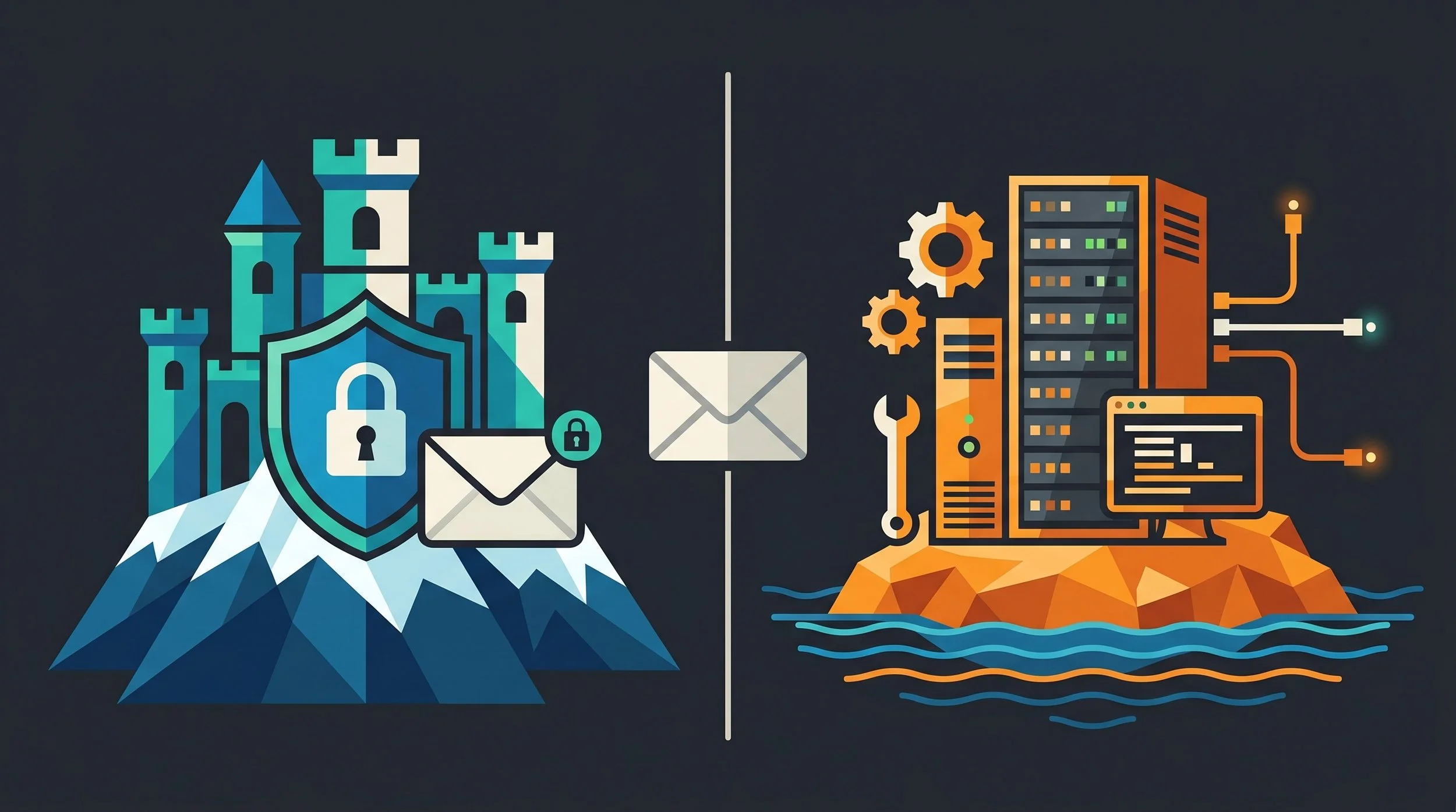
In the privacy community although there are a lot of options and alternatives, this debate usually splits into two camps: those who trust Proton Mail and those who insist on Self-Hosting. To the uninitiated, this looks like a choice between two versions of "secure email." In reality, it is a choice between two entirely different philosophies of trust: Institutional Trust versus Technical Autonomy.
The Fortress of Swiss Privacy: The Case for Proton Mail
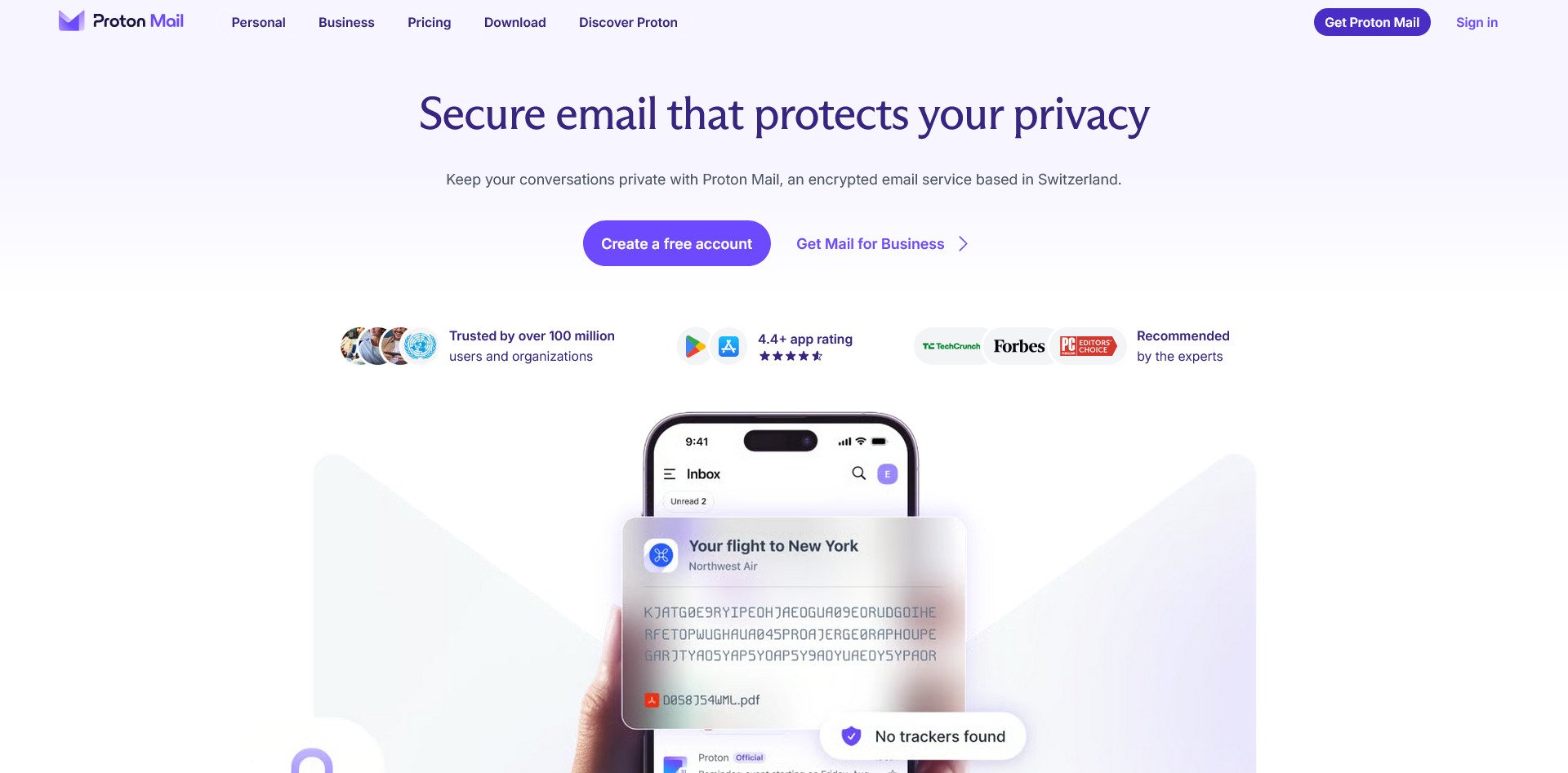
Proton Mail Website
Proton Mail is not just another "privacy-focused" email provider. It is a company designed from the ground up to be a legal and technical fortress. To understand why Proton is the gold standard for "Managed Privacy," we have to look at the two pillars they stand on: Jurisdiction and Mathematics.
The Strategic Advantage of Swiss Law
Privacy is not just about software; it is about the law of the land where the server physically sits. Proton is based in Geneva, Switzerland, a choice that is a calculated strategic move.
Swiss privacy laws are among the most stringent in the world. Unlike the "Five Eyes" intelligence alliance (which includes the US, UK, Canada, Australia, and NZ), Switzerland maintains a high level of legal independence. This means that the "convenience" of a US-based provider often comes with a backdoor for government agencies. In Switzerland, the legal hurdles to seize data are exponentially higher. This provides a layer of protection that no "Terms of Service" agreement can match, it’s a legal shield backed by strict data protections.
Zero-Access Encryption: Trusting the Math, Not the Company
The most powerful part of the Proton architecture is that they have removed "trust" from the equation. Through zero-access encryption, Proton ensures that they cannot read your emails, even if they wanted to.
When you send an email through Proton, it is encrypted on your device using your own key before it ever reaches their servers. If a government agency serves Proton with a warrant for your emails, Proton can comply, they can provide the encrypted data—but they cannot provide the plaintext. They don't have the key.
This is the pinnacle of "Managed Privacy": you get a professional, polished experience with 99.9% uptime and zero maintenance, but your data remains mathematically private.
The Path of Absolute Autonomy: The Case for Self-Hosting
While Proton is a fortress, a self-hosted server is a private island. For the "Sovereign Operator," a trustworthy company is still a third party. The only way to truly eliminate the "middlemen" is to own the infrastructure.
By using tools like Mailcow, Mail-in-a-Box, or Poste.io, you are choosing to take the burden of administration in exchange for total ownership.
The Power of the Root User
When you host your own mail, you aren't just "using a service", you are the Administrator. This provides a level of control that no managed service can replicate:
Total Data Ownership: Your emails live on a disk in your house or your own private VPS. There is no "account suspension," no "community guidelines" that can be used to silence you, and no corporate policy that can change overnight.
The Sovereign Identity: You don't just have a custom domain; you control the engine that processes it. You decide exactly how your mail is routed, how it's backed up, and who has access to the logs.
Zero Dependencies: You are no longer dependent on a company's solvency or its ethical choices. As long as your hardware has power and an internet connection, your identity exists.
The "Admin Tax": The Brutal Reality of Self-Hosting
We must be honest: self-hosting email is the "final boss" of the self-hosting world. It is a punishing process that requires a specific kind of technical patience.
The struggle is not in the installation; it's in the Deliverability. The internet is a hostile environment for new mail servers. Because of the epidemic of spam, major providers (like Gmail and Outlook) are extremely suspicious of emails coming from "home" IP addresses.
To get your emails delivered, you must navigate a minefield of technical configurations:
PTR/Reverse DNS: You must prove your IP address is linked to your domain.
SPF (Sender Policy Framework): You must explicitly tell the world which servers are allowed to send mail for you.
DKIM (DomainKeys Identified Mail): You must cryptographically sign every email you send.
DMARC: You must tell other servers what to do if the SPF or DKIM checks fail.
One small mistake in any of these, and your emails vanish into a "black hole" of spam folders. Furthermore, you are now the security officer. You must manage your own spam filters, handle your own updates, and ensure that your server doesn't accidentally become an open relay for spammers.
The Strategic Comparison: A Mapping of Trust
To choose your path, you must decide where you sit on the Sovereignty Spectrum.
The Sovereign Strategy: The Hybrid Migration
You don't have to make a binary choice today. a jump from Gmail to a self-hosted server is often too great a leap, leading to "technical burnout." Instead, we recommend the Hybrid Migration Path, a gradual ascent toward total sovereignty.
Step 1: The Exit (Immediate Privacy) Move your primary email to Proton Mail. This immediately removes your data from the "Big Tech" mines and places it under Swiss protection. You get a "Privacy Win" on day one without any technical friction.
Step 2: The Lab (Controlled Learning) Set up a local mail server (like Mailcow) on your Proxmox node. Use it for your "hobby" emails, for testing scripts, or for internal family communication. This allows you to learn the intricacies of SPF, DKIM, and DMARC in a low-stakes environment where a "delivered" failure doesn't affect your professional life.
Step 3: The Migration (Absolute Sovereignty) Once you have mastered your local infrastructure and your IP reputation is solid, migrate your primary domain to your own server. You have now moved from a "Trustworthy Third Party" to "Absolute Ownership."
Note: You can also check this open source guide here for a large list of open-source alternatives.
Conclusion
Whether you trust a Swiss fortress or build your own island, the first step is the same: Stop renting your identity. The "convenience" of email services such as Gmail and Microsoft Outlook are just shackles designed to keep you dependent and mine you for data.
Whether you choose the polished security of Proton or the rugged autonomy of self-hosting, you are taking a stand. You are deciding that your communication is too important to be a commodity.
Your mail. Your server. Your rules.
Stop renting your digital existence.
Buy a board, spin up a container, take your data back.
