Privacy And Anonymity Is Not a Crime
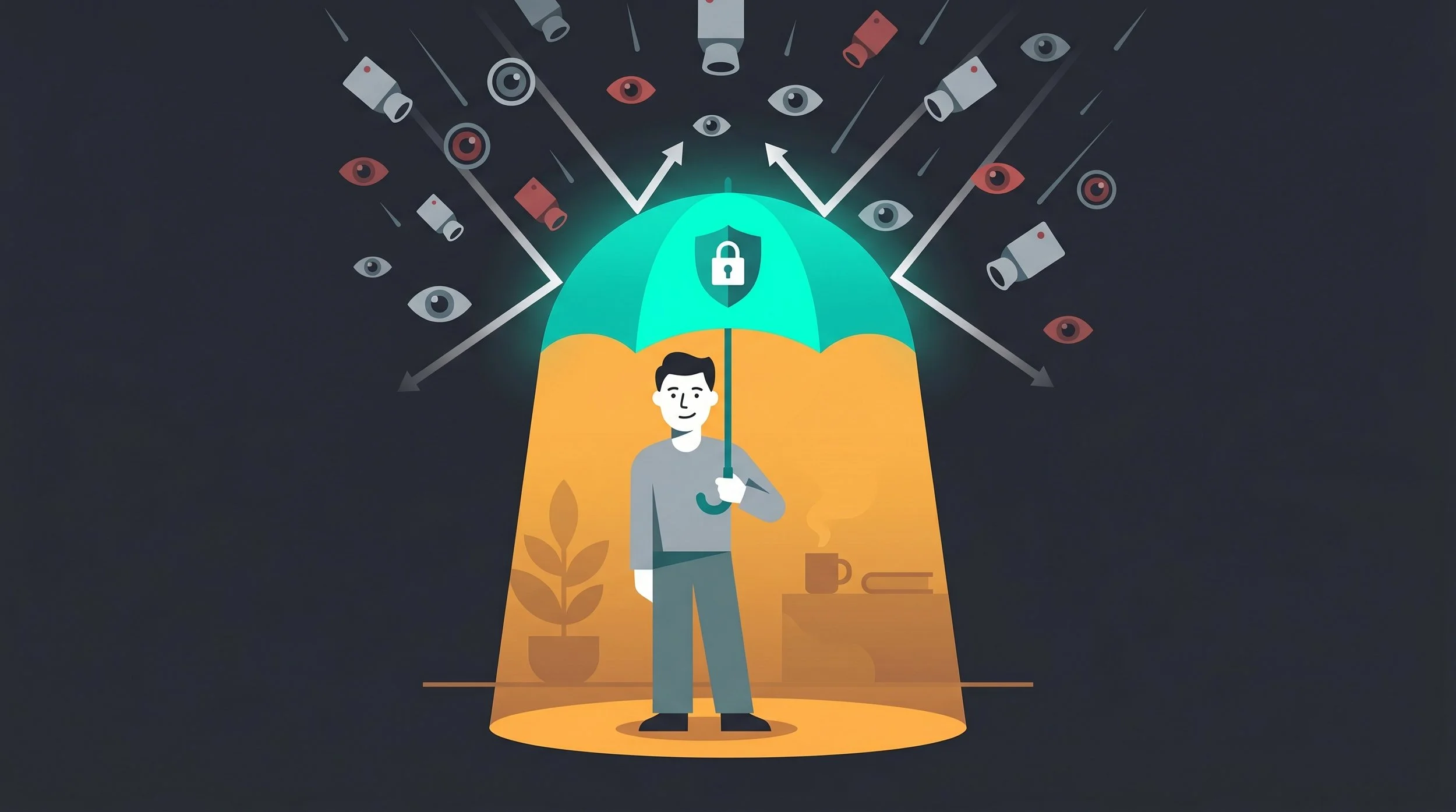
Man holding umbrella shielded from surveillance
Intro
“If you have nothing to hide, you have nothing to fear" - said every tyrant and useful idiot ever. This is by far the most dangerous lie of the digital age. This is a lie that has been sold by governments, institutions, and corporations alike. Isn’t it strange how the same offenders who benefit from your data and lack of privacy are the ones who use this infamous talking point the most?
Anonymity ≠ Criminality
Privacy is a right not some privilege or permission granted by a person, institution, or government. This also should not suddenly change when you connect to the internet or a service. From journalists to whistleblowers to regular people like you, lack of privacy can have an impact.
Without privacy Journalists would not be able to protect sources in oppressive regimes or other dangerous places preventing us from knowing what is happening there. Whistleblowers would have no safe way to tell the truth leaving citizens in the dark about their own government. Activists and protesters can be targeted even if they are not breaking the law. Even you could be targeted for your political opinions, the websites you visit, and much more that you maybe never even thought of. Privacy and Anonymity is what is best for our safety not the opposite.
We hear things all the time such as ”Only criminals use X or Y” for example “Only criminals use Graphene OS“. First off, this is almost never true. The data is always cherry picked and disingenuous almost every time this argument is made, if its even made with any data at all. Second, criminals drive cars too, they also use computers so does that mean cars and computers should be banned because criminals are using them to commit crimes? As you can see this argument falls apart at the seams very quickly when actually scrutinized at face value as do many other anti-privacy arguments.
The "Nothing to Hide" Fallacy
You close the bathroom door, not because you're doing something wrong but because privacy is about boundaries, not guilt. The same principle should apply to the technology and services we use. Over time we have gotten comfortable with our data being stolen and privacy being eroded but with awareness we can slowly take it back not all at once but one step at a time.
People who say they don’t care because they have nothing to hide actually have a lot to hide they just don’t realize it. For example: Medical records, financial info, personal conversations, political beliefs, location data, browsing history, etc. The list goes on most people just forget or don’t realize truly how much they actually do have to hide that should probably stay hidden.
The “Nothing to Hide“ fallacy also assumes power wont be abused which is unrealistic and often not the case. Governments change, laws change, what's legal today might not be tomorrow but your data is the consistent factor. There are no shortage of examples of data collected for the purpose of “safety“ getting misused. Who doesn't want to be safe which is exactly why safety is the ultimate dog whistle used for attacking privacy. It’s always the safety angle, they all just care so much!
The criminalization of privacy and anonymity also have downstream effects with a chilling effect on free speech, the most important right and power we have. People self-censor when they know they are being monitored and keep quiet rather than saying what they actually think about something creating an illusion of consensus that is not at all real.
Rising Threats
It seems as if every week there is some cool new dystopian technology making its way into our future. The proliferation of dystopian technologies is accelerating, with innovations like Palantir’s data aggregation systems and biometric surveillance networks amplifying the growing encroachment on personal privacy.
These tools, often justified as tools for "security" or "efficiency," enable governments and corporations to track individuals in real time, analyze behavior, and predict dissent. For instance, Palantir’s platforms have been deployed in law enforcement and border control, merging disparate datasets to create comprehensive profiles of citizens, often without transparency or oversight.
Similarly, social credit systems which link behavioral data to reputational scores are being implemented in various regions, incentivizing conformity while punishing noncompliance. These systems rely on pervasive monitoring, including facial recognition, location tracking, and digital footprints, to enforce compliance with state or corporate norms. The normalization of such technologies creates a chilling effect on free expression, as individuals self-censor to avoid penalties, further eroding democratic values.
Emerging trends also include AI-driven predictive policing and automated surveillance grids, which use machine learning to flag "risky" behaviors before they occur. These systems disproportionately target marginalized communities, perpetuating systemic biases while expanding the scope of state control. As these technologies mature, the line between security and oppression blurs, making it imperative to resist their unchecked expansion.
The "nothing to hide" fallacy is particularly dangerous in this context, as it distracts from the systemic risks of surrendering privacy. Every piece of data collected: whether it’s your browsing history, location, or biometric identifiers all can be weaponized, sold, or misused. The fight for anonymity is not just about criminals; it’s about preserving the right to live without fear of surveillance, censorship, or coercion.
Taking Back Privacy
Taking back privacy and Anonymity is an uphill battle. It’s much easier to loose rights and privacy than it is to gain them all back. You can start to take back your own privacy by using tools and software services that respect your privacy and avoid the ones that don’t. As long as surveillance is profitable it will continue.
For example instead of using Google for your email and documents, consider switching to Proton which provides a lot of the same services Google does and has a good reputation of respecting privacy through actions rather than words unlike Google. You can also take things a step further by self hosting if you have the hardware for it. Take a good look and reflect on what apps and services you rely on and see what alternatives exist.
There are tons of great projects and solutions to replace products and services that do not respect users. Self-hosted and open-source services can often rival some of the services you are most likely using now. You can learn more from our blog on our website.
Conclusion
Privacy and anonymity are not crimes—they are the bedrock of a free and just society. The "nothing to hide" fallacy is a convenient lie that distracts from the systemic threats posed by unchecked surveillance, data exploitation, and the normalization of control. Every piece of data we share, every action we take online, and every moment of our lives is part of a broader struggle for autonomy, dignity, and resistance to authoritarianism.
The technologies of today such as Palantir’s data grids, AI-driven policing, and social credit systems are all not just tools for "security"; they are mechanisms of power that erode trust, silence dissent, and normalize coercion. The fight for privacy is not about hiding from the world, but about protecting the right to live without fear of being watched, judged, or punished for our thoughts, beliefs, or choices.
But this fight is not impossible. It requires vigilance, education, and collective action. By choosing privacy-respecting tools, supporting open-source projects, and demanding transparency from institutions, we can reclaim control over our digital lives. It also means rejecting the false dichotomy between safety and privacy, recognizing that true security cannot exist without the right to privacy.
The path forward is clear: privacy is a right, not a privilege. The tools to protect it exist, and the time to act is now. Let’s resist the erosion of our freedoms, defend the right to anonymity, and build a future where technology serves humanity not the other way around. The battle for privacy is not just about data it’s about freedom, justice, and the survival of democratic values in the digital age.
Stop renting your digital existence.
Buy a board, spin up a container, take your data back.
