Cloud NVR vs. SourceBox Sentinel: The True Cost of 'Convenience'
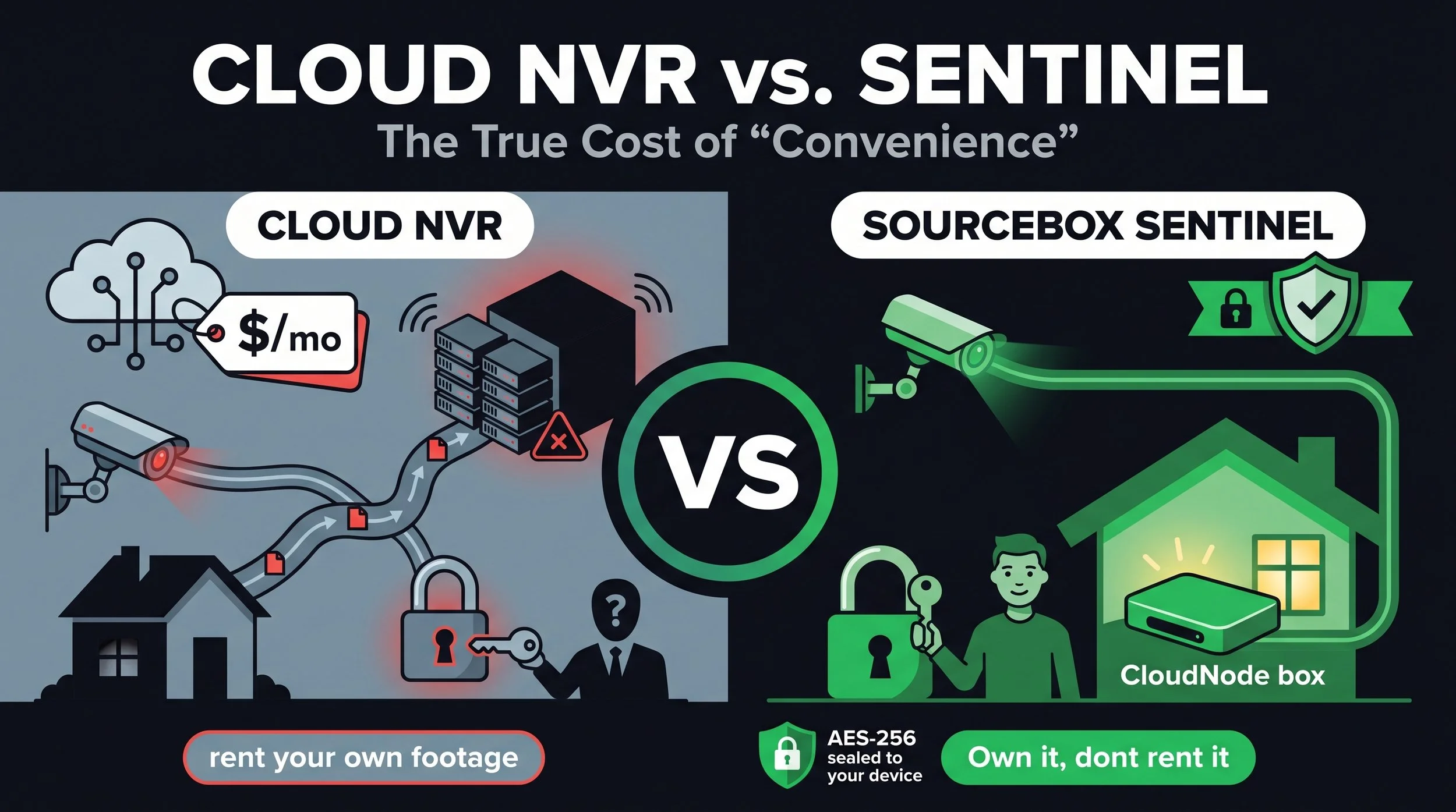
Standard Cloud NVR vs Sentinel
By S’Bussiso Dube/SourceBox Team
In the world of home security, "Convenience" is the most expensive product you can buy.
If you’ve ever shopped for a security system, you’ve seen the pitch. A few sleek cameras, an easy app, and a "low" monthly subscription. It looks like a bargain. But when you peel back the layers, you realize that "convenience" is actually a trade. You are trading the ownership of your most private moments for a slightly easier setup process.
At SourceBox, we believe this trade is a bad deal. Here is the breakdown of the True Cost of the cloud-camera ecosystem versus the Sovereign Path of SourceBox Sentinel.
You can learn more about the price of convenience here.
Renting vs. Owning
The Financial Cost: Subscription Creep vs. Asset Ownership
The Cloud NVR Model: You buy the hardware, but you don't actually own the system. You are renting access to your own footage. If you stop paying the monthly fee, your "smart" camera becomes a plastic brick. Over five years, a "cheap" 10 dollars/month subscription piles up and becomes a huge tax on your own home year after year.
The Sentinel Model: You invest in your own hardware. Whether it's a Raspberry Pi or a dedicated server, you own the asset. There are no "feature gates" that lock basic functionality behind a paywall. You aren't renting your security; you're building an infrastructure asset.
The Privacy Cost: The “Black Box" Problem
The Cloud NVR Model: When a corporate camera detects "motion," that footage is streamed to a remote data center. A proprietary AI in which you cannot audit then decides what is important. Your private life is converted into data points for a vendor’s AI training set. You have a "Privacy Policy," but you have no technical guarantee.
The Sentinel Model: Sovereignty is built into the code. Sentinel uses a Local-First architecture. Motion detection and recording happen on your Camera Node, inside your own four walls. We use AES-256-GCM encryption sealed to your device's unique machine ID. If a third party (or even we) wanted to see your footage, they couldn't because we don't have the keys. We don't just promise privacy; we make it as difficult as possible to violate it in the first place.
The Reliability Cost: The "Cloud Outage" Risk
The Cloud NVR Model: Your security is only as good as your internet connection and the vendor's server uptime. If the company's API goes down, or your ISP has a hiccup, your "security" system stops securing. In the worst cases, companies go bankrupt or change their terms, and your historical footage vanishes overnight.
The Sentinel Model: Because the recording and analysis happen on your Camera Node, Sentinel works regardless of the internet. Your footage is saved to your local disk in real-time. The "Command Center" in the cloud is merely a window to view that data, it’s not the place where the data lives. If the cloud goes dark, your evidence is still safe on your hardware.
The Intelligence Cost: Rigid Rules vs. AI Agency
The Cloud NVR Model: Most cloud systems give you a few binary options: "Person Detection" or "Package Detection." You are limited to whatever features the vendor decides to push in the next update.
The Sentinel Model: By leveraging the Model Context Protocol (MCP), Sentinel transforms your system into an AI asset. Instead of a rigid set of rules, you have an agent. You can ask your AI, "Did the dog get into the trash this morning?" and the agent investigates the footage on your behalf. You aren't limited by a vendor's feature list; you are limited only by the capabilities of the AI models you choose to run.
What is the True Price?
The Verdict: Convenience is a Product. Sovereignty is a Right.
The "convenience" sold by cloud NVR providers is a carefully designed trap. By making the setup effortless, they convince you to ignore the fact that you've surrendered your data, your privacy, and your long-term ownership. You aren't just paying a monthly fee; you are paying with your digital sovereignty.
SourceBox Sentinel is designed for those who refuse that trade. By decoupling the convenience of the cloud from the ownership of the data, we provide a system that is secure by architecture, not by promise.
Stop renting your security. Start owning your infrastructure.
Stop renting your digital existence.
Buy a board, spin up a container, take your data back.
